A garbage disposal is one of those appliances nobody thinks about — until it starts humming instead of grinding, leaking onto the cabinet floor, or backing up the sink entirely. For homeowners across Vernon, Tolland, Manchester, and the rest of Hartford County, disposal problems are often made worse by two very local factors: hard, mineral-heavy water that leaves scale on internal components, and a fair number of households on well water or older septic and sewer connections that are less forgiving of grease and food waste than a modern municipal system.
The good news is that most disposal problems fall into a handful of predictable categories, and several of them are safe to troubleshoot yourself in a few minutes. This guide walks through the most common symptoms, what’s usually causing them, what you can safely try before calling a plumber, and the situations where calling a licensed professional is the right call from the start.
How a Garbage Disposal Works, in Brief
A garbage disposal uses a spinning plate (not actual blades, despite the nickname) to fling food waste against a shredder ring, breaking it into small pieces that are flushed down the drain with running water. Most residential units have a reset button at the bottom and a hex-shaped opening that accepts an offset wrench to manually free a jam — both of which come up often in the troubleshooting steps below.
The Most Common Garbage Disposal Problems
Humming, but the blades won’t spin
This is almost always a jam, not a motor failure. Something — a fruit pit, a piece of bone, or fibrous food — is physically blocking the plate from turning, and the motor is straining against it. It can also mean the impeller has seized from lack of use.
Leaking from the bottom or sink flange
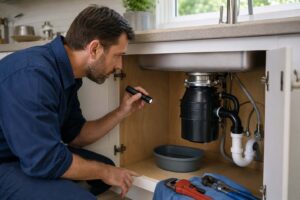
A leak at the base of the unit usually points to worn internal seals, while a leak higher up, around the sink flange, often means the plumber’s putty or gasket sealing the disposal to the sink has failed. Either way, a leaking disposal near electrical components is a safety concern, not just a nuisance.
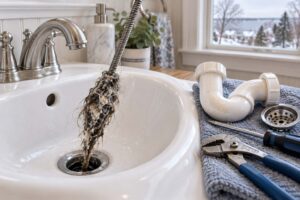
Persistent clogs or slow draining
This is frequently a fats, oils, and grease (FOG) problem. The U.S. Environmental Protection Agency has identified grease from restaurants, homes, and industrial sources as the leading cause of reported sewer blockages, responsible for an estimated 47% of cases1. Connecticut’s own environmental regulators take FOG seriously enough to run a dedicated permitting program addressing the sewage backups it causes2. A garbage disposal does not break down grease — it just chops the solids floating in it, and the grease itself still coats your pipes and hardens as it cools.
Bad odors
Trapped food particles decomposing inside the grinding chamber are the usual culprit, especially when a household regularly runs the disposal without much water.
Safe DIY Steps to Try First
- Turn off power at the wall switch and unplug the unit under the sink. Never reach into a garbage disposal that’s connected to power, even if you’re confident it’s off.
- Look for and press the red reset button. It’s usually on the bottom of the unit and trips automatically when the motor overheats or jams.
- Use the offset wrench (if included) in the bottom hex opening. Turning it back and forth can free a minor jam without ever putting a hand near the blades.
- Check for visible obstructions from the sink side using tongs or pliers — never your fingers — once the power is confirmed off.
- Run cold water while operating the disposal, which helps flush waste through and keeps grease from congealing inside the unit.
What Not to Put Down Your Disposal
A surprising number of common kitchen items are hard on both the disposal and the pipes and sewer line downstream:
- Fats, oils, and grease of any kind — pour into a container and throw away instead
- Fibrous vegetables like celery, corn husks, and onion skins, which can wrap around the impeller
- Bones, fruit pits, and other hard items
- Coffee grounds and eggshells, which accumulate as fine sediment rather than breaking down cleanly
- Pasta, rice, and starchy foods, which continue to expand after they’re ground
- Non-food items of any kind, including produce stickers and twist ties
When to Call a Licensed Plumber
Some situations are worth skipping the DIY steps altogether:
- The unit leaks, especially near electrical connections
- You smell burning or the motor hums continuously without the reset button helping
- The disposal is more than 8–10 years old and struggling regularly
- Your home is on well water or a septic system, where a disposal backup can affect more than just the kitchen sink
- Clogs keep recurring even after you’ve addressed what’s going down the drain
Why Hartford County Homeowners Trust Ray Page Plumbing
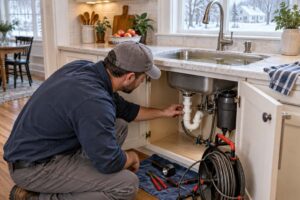
Ray Page Plumbing is a locally owned, licensed, and insured plumbing contractor serving Vernon and the surrounding communities of Hartford County. We regularly repair and replace garbage disposals in homes dealing with the region’s hard water and, for many households, well water and septic systems, which make proper disposal even more important. When a disposal problem turns out to be more than a jam or clog, our team can diagnose it correctly the first time and recommend a repair or replacement that fits your kitchen and budget.
Proudly Serving Hartford County
Ray Page Plumbing provides residential plumbing services throughout Vernon, Tolland, Manchester, Ellington, Rockville, South Windsor, and East Windsor, Connecticut. From a quick disposal repair to a full replacement, our licensed team is ready to help.
Frequently Asked Questions
How long should a garbage disposal last?
Most residential units last 8 to 12 years with normal use. Households on hard water often see mineral scale shorten that lifespan, which is one more reason routine care matters in Hartford County homes.
Is it safe to run my garbage disposal without water?
No. Running a disposal dry lets food waste sit in the unit instead of flushing through, which can contribute to odors, corrosion, and clogs further down the line. Always run cold water before, during, and briefly after use.
Can I put ice cubes down the disposal to clean or sharpen it?
Ice can help knock loose stuck-on debris, but it doesn’t sharpen anything — disposals use blunt impeller plates, not blades. For a genuinely clean unit, a plumber can inspect the grinding chamber and clear buildup that ice alone won’t reach.
Get Your Garbage Disposal Fixed Right
If your garbage disposal is humming, leaking, or backing up your sink, don’t force it. Call Ray Page Plumbing today at (860) 926-4842 or email info@raypageplumbing.com to schedule a repair or replacement.
Sources
- U.S. Environmental Protection Agency, “Controlling Fats, Oils, and Grease Discharges from Food Service Establishments,” EPA-833-F-12-003 — https://19january2021snapshot.epa.gov/sites/static/files/2020-02/documents/pretreatment_foodservice_fs1.pdf
- Connecticut Department of Energy & Environmental Protection (CT DEEP) FOG General Permit, via University of Connecticut Environmental Health & Safety — https://ehs.uconn.edu/environmental-programs-home/water-management/fog/
- California American Water, “Tips for Disposal of Fats, Oils and Cooking Grease to Protect Residential Plumbing and Wastewater Systems” — https://www.businesswire.com/news/home/20241125586146/en/California-American-Water-Provides-Tips-for-Disposal-of-Fats-Oils-and-Cooking-Grease-to-Protect-Residential-Plumbing-and-Wastewater-Systems