A slow drain is easy to ignore. Water still goes down — just not as fast as it used to. Most homeowners in Connecticut put up with it for weeks, sometimes months, before it becomes a full blockage or backup. By that point, what could have been a simple cleaning job has sometimes turned into something more involved.
We’ve been clearing drains in Connecticut homes since 2007, from single-family houses in Vernon and Ellington to older multi-unit properties in Hartford and New Britain. In that time, we’ve seen every kind of clog imaginable — and a few things that had no business being in a drain at all. The one consistent pattern is that clogs rarely appear without warning signs, and catching them early makes a real difference.
This guide covers what causes drain problems in Connecticut homes, how to recognize when a clog is becoming serious, what professional drain cleaning actually involves, and when a slow drain might point to something bigger.
Why Connecticut Homes Are Prone to Drain Problems
Drain issues happen everywhere, but a few Connecticut-specific factors make them more common than homeowners might expect.
Older housing stock is the biggest factor. A significant portion of Connecticut’s residential housing was built before 1960, and many of these homes still have their original cast-iron or clay-tile drain lines. Cast iron corrodes over time, developing rough interior surfaces that catch grease, hair, and debris far more easily than smooth modern PVC pipe. Clay tile lines — common in older sewer laterals — can crack, shift, and allow root intrusion as the surrounding soil moves through freeze-thaw cycles.
Speaking of freeze-thaw cycles: Connecticut’s winters put real stress on underground pipes. Over decades, ground movement can cause older sewer lines to belly—meaning a section of pipe sags and creates a low point where waste and debris collect instead of flowing through. A bellied pipe won’t clear with a plunger or a store-bought drain cleaner. You need to identify it and address it at the pipe level.
Tree root intrusion is another issue that’s particularly prevalent in Connecticut’s older, more established neighborhoods. Roots seek out moisture and follow it into any available crack or joint in a sewer line. Once inside, they grow and catch debris until the line is fully obstructed. The EPA notes that root intrusion is one of the leading causes of sewer backups in residential systems nationwide.[1]
The Most Common Causes of Drain Clogs We See in CT
Most residential drain clogs come from a handful of predictable sources. Knowing what they are helps you avoid them — and helps you understand what a plumber is dealing with when they arrive.
Grease and fat buildup. This is the number one cause of kitchen drain clogs. Cooking grease feels liquid when it’s hot, but it cools and solidifies inside your pipes. Over time, layer upon layer builds until the drain is nearly or completely blocked. The Water Environment Federation estimates that grease causes nearly half of all sewer overflows in the United States.[2] Running hot water while pouring grease down the drain helps temporarily, but it doesn’t prevent buildup—it just moves it further down the line.
Hair and soap scum. Bathroom drains — particularly shower and tub drains — are almost always clogged by a combination of hair and soap residue. Hair binds together and catches everything else that flows past. The longer it sits, the denser and more difficult the clog becomes. Drain screens help significantly, but they don’t eliminate the problem.
Wipes and hygiene products. “Flushable” wipes are not actually safe for home plumbing systems, despite what the packaging says. The American Society of Civil Engineers and multiple wastewater authorities have documented that so-called flushable wipes do not break down like toilet paper. They are a leading cause of residential sewer blockages.[3] Paper towels, cotton swabs, and feminine hygiene products also have no business going down a drain or toilet.
Mineral scale. In parts of Connecticut with harder water, mineral deposits can slowly accumulate inside drain pipes just as they do inside water heaters. This narrows the pipe’s interior diameter over time, making other clogs more likely to catch and hold.
Tree root intrusion. As mentioned above, this is more of a structural issue than a conventional clog, but the symptom — a slow or backed-up drain — looks the same from inside the house. Root intrusion requires professional equipment to diagnose and address.
Warning Signs Your Drains Are Telling You Something
Drain problems rarely come out of nowhere. Here are the warning signs that something is developing and shouldn’t be ignored:
Slow draining in one fixture. A single slow drain — just the kitchen sink, or just the bathroom shower — usually points to a localized clog in that branch line. It’s the easiest to address, and it’s the right time to call before it gets worse.
Slow draining in multiple fixtures at once. When more than one drain in the house is slow or backing up, especially on the same floor or in connected areas, it points to a problem further down in the main sewer line rather than an isolated clog. This needs prompt attention.
Gurgling sounds from drains. That gurgling noise after you flush the toilet or drain the tub is air being pushed through a partial blockage. It’s the drain telling you there’s a restriction somewhere in the line.
Water is backing up into other fixtures. If you flush the toilet and water bubbles up in the shower drain, or if running the washing machine causes the floor drain to back up, the main sewer line is likely partially or fully blocked. This is an urgent situation.
Foul odors from drains. Persistent sewer smell coming from drains — not just occasionally, but regularly — can indicate a blockage where organic material is decomposing, or a dry P-trap, or a more serious issue with the vent stack.
What Professional Drain Cleaning Actually Involves
Many homeowners assume professional drain cleaning means a more powerful version of what a plunger does. In practice, it’s quite different — and the right approach depends on what’s causing the problem.
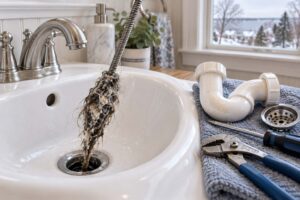
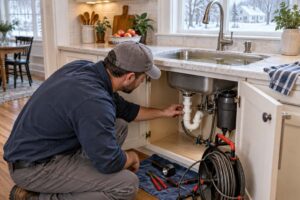
Drain snaking (cable augering). A drain snake is a flexible metal cable with a cutting head that you feed into the pipe to break through or retrieve a clog. It’s effective for localized blockages — a hair clog in a shower drain, a grease buildup in a kitchen sink line — and is often the first tool used on a service call. Snaking clears the immediate obstruction but doesn’t clean the pipe walls the way hydro jetting does.
Hydro jetting. Hydro jetting uses high-pressure water — typically 1,500-4,000 PSI — to scour the interior walls of a drain or sewer line. It removes grease buildup, mineral scale, and debris left by a snake, flushing everything downstream and out of the system. The National Association of Sewer Service Companies recognizes hydro jetting as the most thorough method for clearing drain lines and restoring flow capacity.[4] It’s particularly effective in older Connecticut homes with cast-iron pipes, where buildup has accumulated over decades.
Video camera inspection. When the cause of a drain problem isn’t clear from the symptoms, or when a clog keeps recurring, a camera inspection is the next step. A small waterproof camera is fed through the drain line so the technician can see exactly what’s happening—whether it’s grease buildup, root intrusion, a pipe belly, or a crack. Camera inspections remove the guesswork from diagnosis and prevent unnecessary digging or repairs.
The right method isn’t always obvious from the outside. A professional can assess the situation accurately and choose an approach that solves the problem, not just temporarily restores flow.
When a Drain Problem Is Really a Sewer Line Problem
Not every drain issue is a clog in the traditional sense. Some of the most serious drain problems in Connecticut homes involve the main sewer lateral — the pipe that runs from the house to the municipal sewer or septic system.
Sewer lateral issues are more common in older Connecticut neighborhoods where the original clay or cast-iron lines have been in the ground for 50, 60, or 70 years. Root intrusion, pipe bellies, offset joints, and partial collapses all present as slow or backing-up drains but can’t be resolved by snaking or jetting alone.
Connecticut homeowners are generally responsible for the sewer lateral from the house to the property line, and in some municipalities, to the main sewer connection at the street. If a camera inspection reveals a structural problem with the lateral, repair options range from spot repair of a damaged section to trenchless pipe lining—a method that installs a new pipe inside the old one without excavating the yard—to full replacement in severe cases.
The Connecticut Department of Energy and Environmental Protection provides guidance to municipalities and homeowners on sewer infrastructure maintenance and the homeowner’s responsibility for lateral lines.[5] If you’re not sure where your responsibility ends and the municipality’s begins, your local public works department can tell you.
What You Can Do to Keep Drains Clear
Professional cleaning handles what’s already built up. A few habits prevent it from building up in the first place:
- Put a hair catcher on every shower and tub drain, and clean it after every few uses.
- Never pour cooking grease, bacon fat, or oil down the kitchen drain — collect it in a container and dispose of it in the trash.
- Run hot water for thirty seconds after washing dishes to help flush any residual grease through the line.
- Only flush toilet paper — nothing else, regardless of what the packaging says.
- Periodically pour a kettle of boiling water down kitchen drains to help soften and flush grease before it hardens.
- Have drain lines professionally cleaned every one to two years if you live in an older home or have had recurring clog issues.
Store-bought chemical drain cleaners are worth mentioning here: they can dissolve organic clogs in the short term, but they’re caustic enough to damage older pipe materials over time, and they do nothing for root intrusion or pipe structural issues. They’re also a temporary fix—they don’t remove the underlying buildup; they just punch a temporary hole through it. We do not recommend relying on them as a regular solution.
FAQ: Drain Cleaning in Connecticut
How do I know if I need professional drain cleaning or if I can handle it myself?
If a plunger doesn’t clear it within a few attempts, or if the slow drain has been getting worse over time, call a professional. Store-bought chemical cleaners may temporarily open a drain, but they won’t address the underlying buildup — and on older Connecticut pipes, they can cause more harm than good over time. If more than one drain is slow or backing up, definitely call a plumber rather than trying to DIY it.
How much does drain cleaning cost in Connecticut?
Standard drain snaking for a localized clog typically runs between $150 and $350, depending on the fixture and accessibility. Hydro jetting is more involved and generally costs more, reflecting the equipment and thoroughness of the service. Camera inspections are an additional service. Costs vary based on what’s needed—an on-site diagnosis gives you the clearest picture before any work begins.
Why does my drain keep clogging even after it’s been cleaned?
Recurring clogs usually mean one of two things: either the root cause hasn’t been addressed (for example, grease is still going down the drain regularly), or there’s a structural issue — like a pipe belly, root intrusion, or significant buildup on the pipe walls — that snaking alone can’t fully resolve. A camera inspection is the best way to get a definitive answer when a drain keeps coming back.
What’s the difference between drain snaking and hydro jetting?
Snaking breaks through or pulls out a clog at a specific point. Hydro jetting uses high-pressure water to clean the entire interior surface of the pipe — walls included — removing grease, scale, and debris throughout. Snaking is often the right first step for a simple clog; hydro jetting is more thorough and more effective for recurring issues or lines with significant buildup.
Are “flushable” wipes really safe to flush?
No. Despite the labeling, flushable wipes do not break down like toilet paper and are among the leading causes of residential drain blockages. Multiple wastewater authorities and engineering organizations have documented this. Toilet paper is the only paper product that should go down a toilet.
Can tree roots really get into my drain pipes?
Yes — and it’s more common than most homeowners realize, especially in older Connecticut neighborhoods with mature trees and aging clay or cast iron sewer lines. Roots follow moisture into even hairline cracks or loose joints and grow from there. Once roots are inside a line, you need to mechanically cut them out and assess the underlying pipe condition. If the line is significantly compromised, you may need repair or relining.
How often should I have my drains professionally cleaned?
For most households, once every year or two is reasonable preventive maintenance — particularly for kitchen lines and main sewer laterals. If you live in an older Connecticut home, have had recurring clogs, or have large trees near your sewer line, more frequent cleaning may make sense. It’s much less expensive than dealing with a backup or a damaged line.
Sources
- U.S. Environmental Protection Agency — Sewer Overflow and Root Intrusion: https://www.epa.gov/npdes/sanitary-sewer-overflows-ssos
- Water Environment Federation — Fats, Oils, and Grease (FOG): https://www.wef.org
- American Society of Civil Engineers — Infrastructure Report Card, Wastewater: https://infrastructurereportcard.org/cat-item/wastewater-infrastructure/
- National Association of Sewer Service Companies (NASSCO): https://www.nassco.org
- Connecticut DEEP — Wastewater Management: https://portal.ct.gov/DEEP/Water/Inland-Water-Quantity/Wastewater-Management